
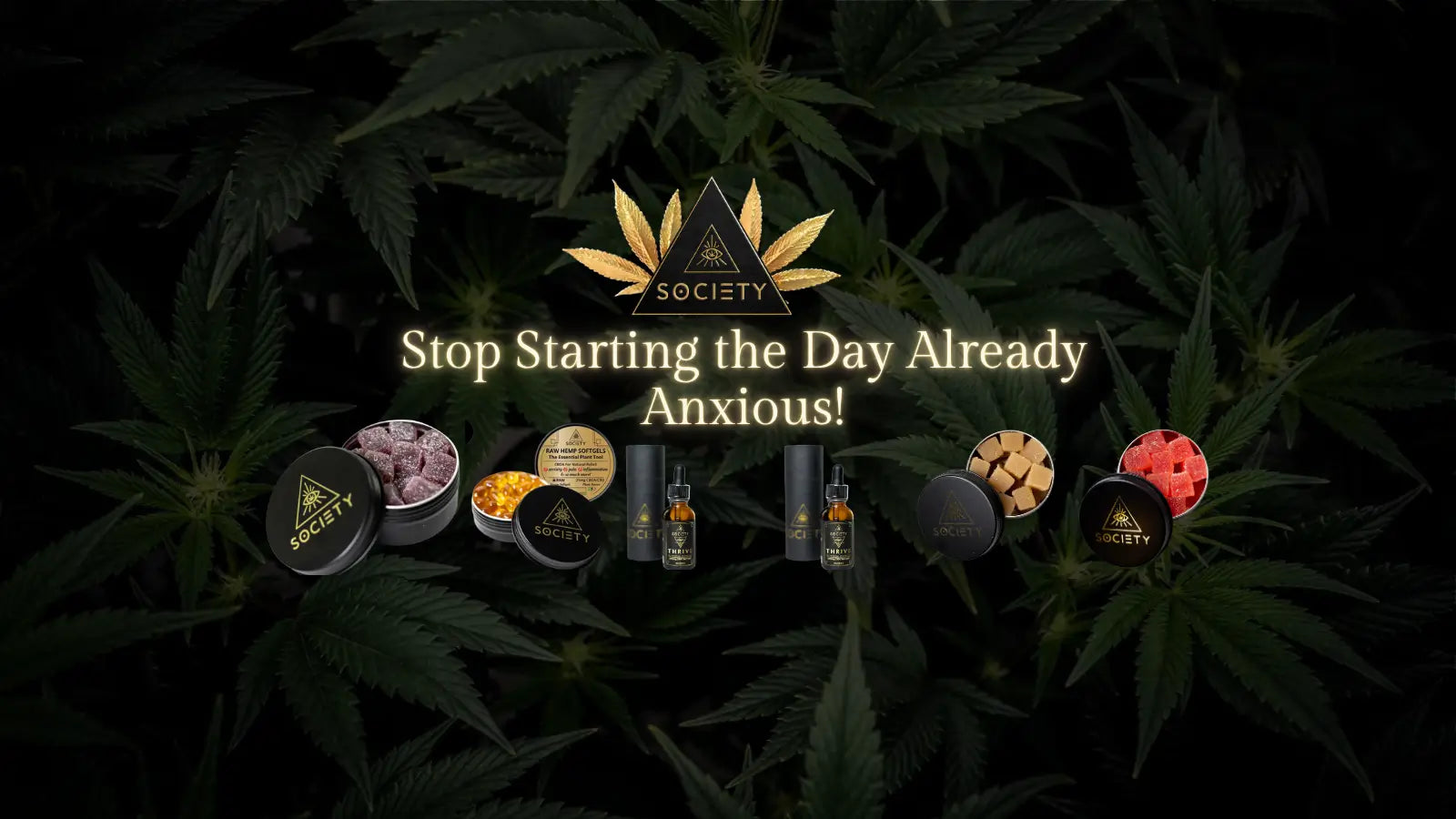
Best Cannabis for Anxiety When You Wake Up
Anxiety When You Wake Up? TL;DR
Anxiety when you wake up, that chest-tight, cortisol-flooded feeling before the day has technically started, is one of the most consistent patterns reported across Society's Plant's community of over 130,000 adults. Different anxiety windows require different cannabinoid tools: a morning softgel, a midday microdose, and a nighttime CBN gummy are not interchangeable. This guide maps each moment to the right Society's Plant product, explains the science behind why it works, and gives specific timing and dosing so there is no guesswork.
- Raw CBDA Softgels taken at bedtime create a sustained anti-anxiety baseline that is still active when cortisol spikes in the early morning hours
- Good Day CBG Gummies are the clearest first-hour option: low-dose, functional, and compatible with a full morning routine
- Focused Microdose Gummies are the midday bridge, combining 2mg THC with CBG, THCV, Lion's Mane, and L-Theanine for sustained focus without the afternoon crash
- Situational anxiety responds fastest to the D9 THC Disposable Vape Pen in Sour Tangie, with onset in 5 to 15 minutes and effects that clear in 1 to 3 hours
- Nighttime anxiety that disrupts sleep belongs to a separate category: Good Night CBN Gummies and the Chill Functional Mushroom Tincture address the root cause rather than just sedating the symptom
That 3 a.m. Brain That Doesn't Clock Out
Most people experiencing morning anxiety are not having a random bad day. The pattern is neurological. Cortisol follows a circadian rhythm, peaking in the first 30 to 45 minutes after waking in a phenomenon researchers call the Cortisol Awakening Response. For a well-regulated nervous system, this is a clean, neutral activation signal. For an anxious one, it reads as a threat alarm.
The body then performs what feels like an involuntary threat audit: unfinished tasks, unresolved conversations, low-grade physical tension held overnight. None of it is a reflection of what is actually happening in the room. It is a nervous system that has been running on a depleted endocannabinoid system for too long, and the morning cortisol spike is simply the moment it becomes impossible to ignore.
The endocannabinoid system, specifically the CB1 receptors concentrated in the amygdala and prefrontal cortex, plays a direct role in modulating how the brain interprets threat signals. When the endocannabinoid system is well-supported, the brain's threat response is proportionate. When it is depleted, ordinary morning stimuli can register as emergencies. This is the gap that specific cannabinoids are designed to fill.
Key takeaway: Morning anxiety is not a mindset problem. It is a nervous system regulation problem, and cannabinoids interact with that system directly at the receptor level.
Which Society's Plant Product Is Right for Your Anxiety Moment?
The right product depends on three variables: when the anxiety peaks, how fast a response is needed, and whether the context allows for any perceptible effect on alertness. The table below maps Society's Plant products to each anxiety window with specific timing and dose guidance.
|
Anxiety Window |
Best Product |
Key Cannabinoids |
Onset Time |
THC Content |
|
Morning (waking anxiety) |
Raw CBDA Softgels (taken night before) |
CBDA, full spectrum |
Baseline effect by morning |
Trace (Farm Bill compliant) |
|
Morning (first hour) |
CBG, 1.5mg THC, Lion's Mane |
45 to 60 min |
1.5mg (very low) |
|
|
Midday / situational focus |
2mg THC, CBG, THCV, L-Theanine |
30 to 45 min |
2mg |
|
|
Situational spike (fast) |
D9 THC, Limonene terpenes |
5 to 15 min |
Present, variable |
|
|
Nighttime / racing mind |
40mg CBD, 20mg CBN, Reishi |
45 to 60 min |
Trace (Farm Bill compliant) |
|
|
Nighttime (zero THC option) |
Functional mushroom blend |
30 to 45 min |
Zero THC |
How Cannabis Calms the Anxious Nervous System
Cannabis works on anxiety by interacting with the endocannabinoid system, a network of receptors distributed throughout the brain, gut, immune system, and peripheral nervous system. CB1 receptors in the amygdala regulate fear response and emotional memory. CB2 receptors in peripheral tissues modulate inflammation, which is increasingly understood to be a driver of anxiety rather than a separate condition. Cannabinoids like CBDA, CBG, and low-dose THC each engage this system differently, which is why the specific formulation matters far more than simply taking "CBD."
Why CBDA and CBG Work Differently Than Standard CBD
CBDA is the raw, CO2-extracted precursor to CBD, and it works through a distinct mechanism that standard CBD does not replicate. While CBD modulates CB1 and CB2 receptors indirectly, CBDA activates 5-HT1A serotonin receptors directly, according to 2013 research on CBDA and serotonin receptor activity. This serotonin pathway is the same one targeted by many pharmaceutical anxiety medications, which is significant context for why CBDA produces a calming effect that users often describe as more immediate and body-wide than standard CBD.
CBG, the other primary cannabinoid in Society's Plant's morning formulas, works through yet another pathway. It acts as an alpha-2 adrenergic agonist, meaning it can modulate the fight-or-flight stress response at a physiological level. Because CBG and CBDA work through complementary but non-overlapping pathways, stacking them in the same product produces a broader calming effect than either cannabinoid could achieve alone.
This distinction is central to why CBDA absorbs and activates differently than CBD in the body. Society's Plant's Raw CBDA Softgels are co2 extracted specifically to preserve CBDA in its active acidic form rather than converting it to CBD through heat or processing. That is a deliberate formulation choice, not a default.
Key takeaway: CBDA and CBG support anxiety relief through serotonin and adrenergic pathways that standard CBD does not directly access, making them particularly useful for morning cortisol management.
The Endocannabinoid System and Morning Cortisol
The endocannabinoid system does not operate on a fixed schedule, but cortisol does. The Cortisol Awakening Response drives a 50 to 100 percent increase in cortisol within the first 30 minutes of waking. For most people, this is a functional activation signal. For people with chronic stress, elevated inflammation, or a depleted endocannabinoid tone, this cortisol spike collides with an under-regulated stress response system and produces the physical sensation of morning anxiety before any external stressor has occurred.
Endocannabinoid tone, the baseline level of cannabinoid activity in the system, is depleted by chronic stress, poor sleep, inflammation, and inconsistent nutrition. Supplementing with CBDA the night before essentially pre-loads the system so that the morning cortisol spike meets a more regulated nervous system rather than an exhausted one. This is the logic behind Society's Plant's recommendation to take Raw CBDA Softgels at bedtime rather than first thing in the morning.
What the Research Says About Cannabinoids and Anxiety
The research on cannabinoids and anxiety is early but directionally consistent. A 2008 study on CBDA and COX-2 enzyme inhibition demonstrated anti-inflammatory activity comparable to aspirin, which matters for anxiety because neuroinflammation is increasingly identified as a co-occurring driver of anxiety disorders rather than a separate issue. When inflammation in the brain's limbic system is reduced, the hypervigilance that characterizes anxiety tends to decrease alongside it.
Beyond CBDA, research on CBD and low-dose THC has shown anxiolytic effects in both animal models and small human trials. Critically, the dose matters significantly with THC: low doses tend to reduce anxiety, while high doses can amplify it in sensitive individuals. This is why Society's Plant's formulations for anxiety specifically use low-dose THC (1.5mg to 2mg in daytime products) rather than the 5mg to 10mg range found in products designed for relaxation or recreational use.
Key takeaway: The research supports cannabinoids for anxiety through multiple mechanisms including serotonin receptor activation, inflammation reduction, and endocannabinoid tone support, but dosing precision is essential, especially with THC.
When to Take What: Matched to Your Anxiety Window
Timing cannabinoids correctly matters as much as choosing the right product. A CBN gummy taken in the morning will make most people drowsy. A CBDA softgel taken the morning of a high-stress event missed its optimal window by 12 hours. The following breakdown maps each product to the specific anxiety moment it was formulated to address, with practical timing built in.
Morning Anxiety: Waking Up Already Braced
The most effective approach to anxiety when you wake up is actually to address it the night before. Taking one Raw CBDA Softgel at bedtime creates a sustained anti-inflammatory, serotonin-modulating baseline that is still active during the early morning cortisol spike. Think of it as laying down a nervous system buffer before the alarm goes off.
For the first waking hour, the Good Day CBG Gummies are the most functional pairing. They contain 1.5mg THC alongside CBG and Lion's Mane mushroom for cognitive support. Most people do not feel impaired at 1.5mg THC, though individual responses vary, so starting with one gummy and observing how the body responds is the right protocol. These are compatible with a full morning: coffee, work, commuting, a normal day.
For adults who want targeted cognitive clarity alongside anxiety support, the Laser Focus softgel adds 25mg CBDA, 22mg CBG, and 11mg THCV in a single softgel. THCV has appetite-modulating and energizing properties that complement the anti-anxiety profile of CBDA and CBG without adding sedation. It is a morning formulation built for someone who needs their nervous system calm and their mind sharp at the same time.
- Night before: take 1 Raw CBDA Softgel at bedtime to build an overnight anti-anxiety baseline
- With morning coffee (or shortly after): take 1 Good Day CBG Gummy, allow 45 to 60 minutes for full onset
- If cognitive focus is also needed: substitute or add the Laser Focus softgel, which combines CBDA, CBG, and THCV for both anxiety and clarity
- Start with one product and one dose before layering; observe how your specific endocannabinoid system responds over several days before adjusting
Situational Anxiety: The Meeting, the Crowd, the Unknown
Situational anxiety has a different profile than baseline morning anxiety. It comes on fast, peaks sharply, and is tied to a specific trigger. Gummies and softgels, with their 30 to 60 minute onset window, are not the right tool when anxiety spikes in real time. For situational anxiety, the D9 THC Disposable Vape Pen in Sour Tangie is the most practical option.
Sour Tangie is a sativa-dominant strain with Limonene, Myrcene, and Caryophyllene terpenes. Limonene in particular has a well-established association with mood elevation and stress reduction. The onset is 5 to 15 minutes, effects last 1 to 3 hours, and the format is discreet. However, because THC at higher doses can sharpen anxiety in some people, the approach is two short puffs, a 10-minute wait, and reassessment before taking more. Vaping is not the daily baseline tool; it is the fast-response option for known trigger situations.
For situational anxiety that builds more gradually (a full workday of back-to-back commitments, for example), the Focused Microdose Gummies taken around noon or 1 p.m. provide 2mg THC alongside CBG, THCV, Lion's Mane, and L-Theanine. The L-Theanine in this formula specifically smooths the edge of low-dose THC while supporting sustained cognitive focus, making this the ideal midday product for anxious professionals who need to be present and functional. For a deeper look at how microdosing supports anxious nervous systems, this breakdown of microdose gummies for anxiety explains the cannabinoid logic in detail.
Key takeaway: Situational anxiety needs fast-onset tools (vape) or planned-ahead tools (midday microdose). Matching the delivery method to the anxiety timeline is more important than the cannabinoid dose alone.
Nighttime Anxiety: When Your Brain Won't Let You Sleep
Nighttime anxiety that prevents sleep is a distinct problem from daytime anxiety, even when the underlying nervous system dysregulation is the same. At night, the goal shifts from functional calm to genuine physiological downregulation: lower cortisol, slower heart rate, reduced thought cycling. CBD and CBN together address this more effectively than THC-forward products, which can fragment sleep architecture in some people at higher doses.
The Good Night CBN Gummies contain 40mg CBD, 20mg CBN, and Reishi mushroom. CBN is a mildly sedating cannabinoid that works synergistically with CBD to quiet the nervous system without the rebound cortisol spike that often follows sleep medications. Take one gummy 45 to 60 minutes before the intended sleep time, not right before lying down.
For adults who prefer to avoid all THC or who are building a conservative nightly routine, the Chill Functional Mushroom Tincture contains zero THC and uses an adaptogenic mushroom blend specifically formulated for nervous system calm. It is also the right starting point for anyone whose lifestyle requires avoiding THC entirely. Meanwhile, the Society's Sleep Gummy adds 5-HTP and 3 mg melatonin to the CBN and CBG base for those whose nighttime anxiety is closely tied to sleep onset rather than mid-night waking.
Key takeaway: CBN and high-dose CBD are the right cannabinoids for nighttime anxiety. THC is a secondary tool at night, not the primary one, because high doses can interfere with sleep quality even when they help with initial sleep onset.
What Society's Plant Customers Say About Anxiety Relief
The patterns in customer feedback are consistent enough across thousands of reviews that they start to describe the experience more accurately than any product description could. Three voices from that community are worth including here.
"I have had anxiety when I wake up for years, and I always assumed it was just how I was wired," says Farah, a 41-year-old corporate attorney from LA. "I started taking the Raw CBDA Softgels at night and within about a week I noticed the mornings were different. Not numb, not sedated, just not braced. I still take one every night like a vitamin, and I don't skip it."
"The situational anxiety was the thing I couldn't figure out," says Lara, a 36-year-old marketing director from New Jersey. "I tried the Good Day gummies for general use, and they were great, but for the days I knew were going to be brutal, the Sour Tangie vape was the thing that actually worked fast enough to matter. Two puffs before a big presentation and I could think clearly instead of just white-knuckling it. I appreciate that it clears out of my system in a couple of hours.”
"I was skeptical about the nighttime ones specifically," says Kat, a 44-year-old occupational therapist from Indiana. "I thought I'd wake up groggy. The Good Night CBN Gummies don't do that at all. My brain still goes to a busy place when I lie down, but it settles faster. I wake up without that low-grade dread. The morning anxiety I used to have when I woke up is probably 80 percent less than it was six months ago."
For a broader look at how cannabinoid gummies are being used for mood and anxiety support, these community reviews on gummies for mood cover a wide range of experiences.
Pros and Cons of Using Cannabis for Anxiety: The Straightforward Version
Cannabis is not a replacement for therapy, psychiatric care, or medical evaluation. It is also not the overhyped wellness trend some critics suggest. The honest picture sits somewhere in between, and people making informed decisions deserve both sides.
Pro 1: Cannabinoids interact with anxiety at the physiological level, not just the perceptual one. CBDA activates serotonin receptors. CBG modulates the adrenergic stress response. These are not placebo mechanisms. Because anxiety has measurable physiological drivers, cannabinoids that address those drivers can produce effects that feel qualitatively different from distraction or relaxation techniques alone.
Pro 2: Society's Plant products are Farm Bill compliant and third-party lab tested. Every product has a Certificate of Analysis published at societysplant.com/pages/labs. This matters because cannabinoid products vary enormously in actual content versus label claims. Third-party testing removes that variable.
Pro 3: Low-dose and non-intoxicating options mean anxiety support does not require impairment. The CBDA softgels, the Chill Tincture, and even the 1.5mg THC in Good Day are not tools that take someone out of their day. For functional people who need to stay functional, this is the difference between a tool they can actually use and one they cannot.
Con 1: THC dose sensitivity is real and individual. The same dose that produces calm in one person produces heightened anxiety in another. This is not a product flaw; it is endocannabinoid system variation. The mitigation is simple: start significantly lower than the recommended dose, give it several days before adjusting, and do not push through a bad response hoping it will resolve. However, this requires patience that some people understandably do not want to extend.
Con 2: Cannabinoids address symptoms and physiological drivers, but they do not resolve the source of anxiety. If the anxiety is tied to genuine external stressors (work instability, relationship difficulty, medical concerns), cannabinoids will make those stressors feel more manageable but will not change the underlying circumstances. Used alongside therapy, lifestyle interventions, and medical support where appropriate, they are a strong complementary tool. Used as a substitute for addressing root causes, the benefit plateaus.
Con 3: Onset timing requires planning. A gummy taken after anxiety spikes is 45 minutes away from providing relief. This is not a crisis tool. For people who need immediate response capability, pairing a daily softgel or gummy routine with a fast-onset option like the vape covers both the baseline and the acute window. But it requires some forethought that not everyone is immediately ready to build into a routine.
Frequently Asked Questions About Cannabis for Anxiety
Can I take the CBDA Softgels and Good Day CBG Gummies at the same time in the morning?
Yes, these two products work through different mechanisms and stack well together. The Raw CBDA Softgels work best when taken the night before to build a sustained overnight baseline, so the morning combination would typically be a CBDA softgel from the previous evening still active in your system alongside a Good Day CBG Gummy taken with breakfast. If someone is taking both in the same morning window, onset for the softgel is 45 to 60 minutes and the gummy follows a similar timeline. Starting with each product separately for a few days before layering gives a clearer read on how the body responds to each independently, which makes the stacked experience much easier to interpret.
Why does low-dose THC help anxiety when higher doses can make it worse?
THC has a biphasic dose-response relationship with anxiety, meaning the direction of effect reverses at different dose levels. At very low doses (1mg to 2mg), THC tends to reduce stress and promote a mild sense of ease through CB1 receptor activation in the prefrontal cortex, which helps regulate the amygdala's threat response. At higher doses (above 5mg, and especially above 10mg), THC can overstimulate those same CB1 receptors and amplify anxiety rather than quiet it. This is why Society's Plant's daytime anxiety products use 1.5mg to 2mg THC rather than the 5mg to 10mg range in evening or relaxation formulas. The dose is not incidental, it is the mechanism. For more on how microdosing THC works differently from standard doses, this guide to microdose gummies for daily wellness covers the practical differences in detail.
Are there Society's Plant products that help with anxiety that contain zero THC?
The only products in Society's Plant's full catalog with zero THC are the four functional mushroom tinctures: the Thrive Tincture, the Chill Tincture, the Dream Tincture, and the Flow Tincture. For anxiety specifically, the Chill Tincture is the most directly relevant. All other products, including Good Day, the CBDA softgels, and Good Night CBN Gummies, contain trace to low amounts of THC and are Farm Bill compliant but are not THC-free. Additionally, since many of Society's Plant's products contain naturally occurring THC from hemp, it is worth noting that naturally occurring THC from hemp may show up on a drug test with regular use. Anyone with drug testing requirements should start with the mushroom tincture line for a fully THC-free option.
How long before bed should I take the Good Night CBN Gummies for nighttime anxiety?
Take the Good Night CBN Gummies 45 to 60 minutes before the intended sleep time, not immediately before lying down. CBN and CBD require time to absorb and reach peak effect, so taking them right at lights-out means the full calming effect arrives after the window when it is most useful. Most people find the 45-minute mark produces a noticeable shift in mental pace around the time they are winding down their final routine. For those whose nighttime anxiety is specifically about racing thoughts at sleep onset rather than mid-night waking, the Society's Sleep Gummy adds melatonin and 5-HTP to the CBN base, which targets sleep onset more directly. For a full breakdown of how CBN compares to other sleep cannabinoids, this comprehensive CBN sleep guide covers the research and practical differences.
Can someone use the Focused Microdose Gummies if they've never used cannabis before and are nervous about THC?
The Focused Microdose Gummies are actually one of the strongest first-time THC recommendations in the Society's Plant lineup specifically because the dose is low and the formulation is stabilizing. At 2mg THC paired with L-Theanine, which is known to smooth the effects of stimulants and cannabinoids, and CBG, which supports focus and calm, this is a controlled and functional introduction. The key is starting with half a gummy (1mg THC effective), taking it around noon when the day is already in motion and there are no high-stakes obligations for the next two hours, and observing how the specific nervous system responds before taking a full dose. Because everyone's endocannabinoid system responds differently, the first experience is informational more than anything else.
Is there a difference between using cannabis for generalized morning anxiety versus anxiety related to a specific event?
Yes, and the distinction matters for product selection. Generalized morning anxiety, where waking up already braced is the baseline regardless of what the day holds, responds best to a daily protocol: CBDA Softgels the night before, a Good Day CBG Gummy in the morning. The consistency is the mechanism. Event-based situational anxiety, on the other hand, benefits from a fast-acting option timed to the specific trigger. The D9 Vape in Sour Tangie works in 5 to 15 minutes and clears in 1 to 3 hours, making it purpose-built for discrete high-stress windows. Using a vape as a daily baseline tool rather than an acute response tool is a different pattern, and one that works less predictably over time as tolerance develops. The two approaches are complementary rather than interchangeable. For a deeper understanding of how these products address the broader anxiety picture, this guide on the best THC gummies for anxiety provides useful context on product selection by anxiety type.
The anxiety that greets people before the first cup of coffee is not random; it is not a character flaw, and it is not something that has to simply be endured. Society's Plant was founded in 2019 by Bianca Snyder and co-founded by Tad Snyder, who has been in cannabis cultivation since 2012. The formulations in this lineup are not wellness aesthetic; they are the result of years of working directly with thousands of adults who needed something that fit into a real day, not an ideal one. The right cannabinoid at the right moment, in the right dose, does not fix everything. But it does change the first 20 minutes of the morning, and anyone who has spent years white-knuckling through those minutes knows exactly how much that is worth.
Related Guides Worth Reading
- How to choose the right THC gummy for anxiety based on dose, timing, and anxiety type
- Why CBDA works differently than CBD for anxiety and inflammation support
- Which cannabinoids in microdose gummies actually move the needle for anxiety
- The complete guide to CBN for sleep and nighttime anxiety: what the research supports
These statements have not been evaluated by the Food and Drug Administration. This product is not intended to diagnose, treat, cure, or prevent any disease. Consult a healthcare professional before starting any new supplement.



Leave a comment
This site is protected by hCaptcha and the hCaptcha Privacy Policy and Terms of Service apply.