
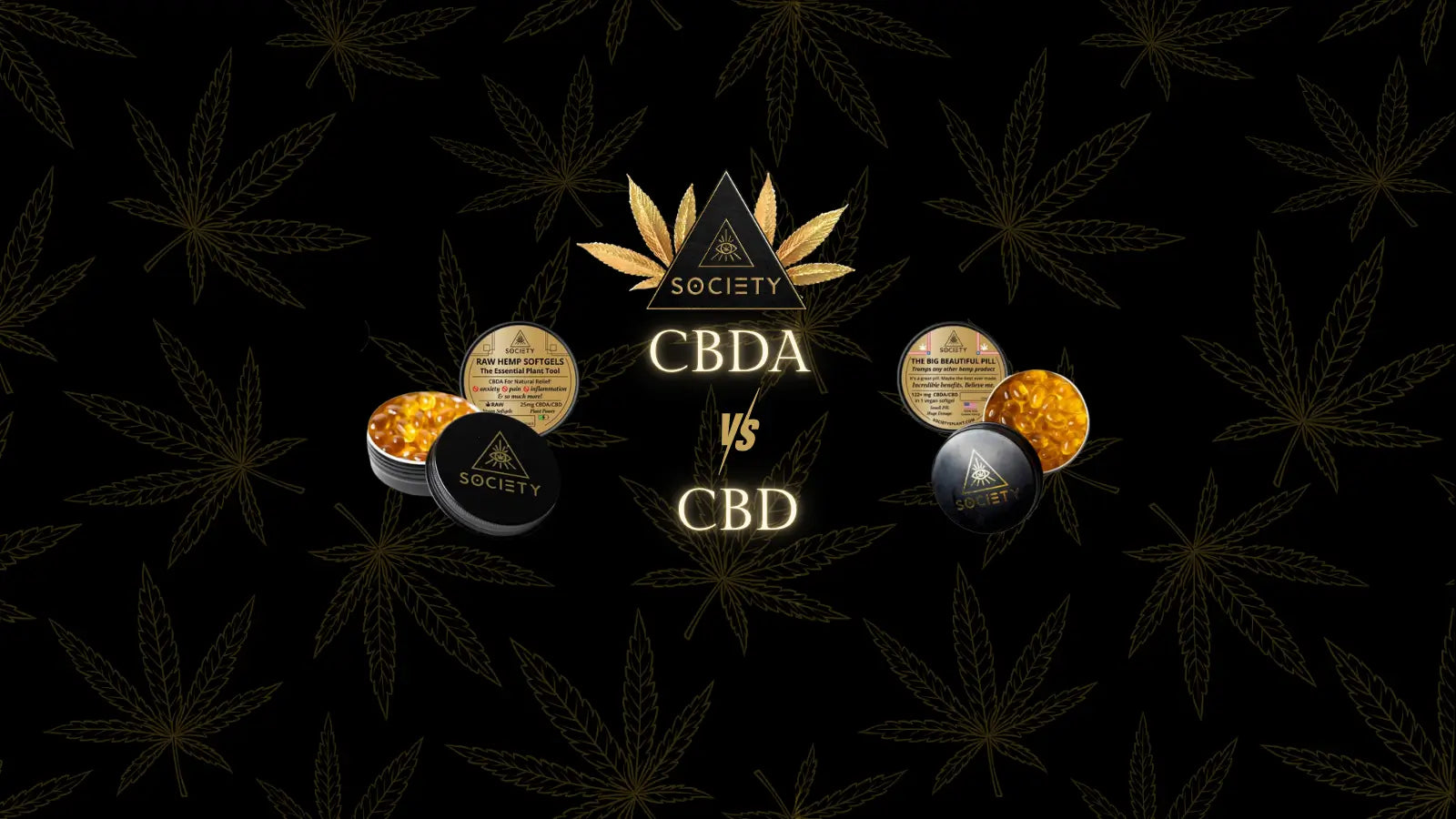
Benefits of CBDA vs CBD: Why Raw Wins Every Time
The benefits of CBDA vs CBD are not a minor footnote in the cannabinoid conversation, they are the entire reframe. Most people who tried CBD and felt nothing were not wrong about hemp. They were working with a compound that, by the time it reached their bloodstream, had already lost most of its potency in transit. CBDA is what exists before the heat, before the processing, before the conversion. Society's Plant is a Michigan hemp farm founded in 2019 by Bianca Snyder, who has built an online community of over 130,000 people and serves over 10,000 customers. Co-founder Tad Snyder has been working in cannabis cultivation since 2012. Together, they built a line of CO2-extracted CBDA softgels specifically because the raw form is that different, and the research backs it up completely.
CBDA and CBD: Same Plant, Completely Different Molecules
Hemp produces CBDA first. When the plant is harvested and exposed to heat, through smoking, vaping, or conventional extraction, CBDA converts into CBD through a process called decarboxylation. For years, the industry treated this conversion as the goal. Decarboxylated CBD is shelf-stable, familiar, and easy to formulate with. However, familiar is not the same as optimal, and the assumption that CBD was the only active compound worth studying has since been challenged by a growing body of peer-reviewed research.
CBDA, the raw acidic precursor, is not a stepping stone to CBD. It is its own compound with its own pharmacological profile, its own receptor interactions, and, critically, its own absorption advantages. The research suggesting CBDA is pharmacologically inert has been thoroughly overturned. What the data actually shows is that CBDA engages COX-2 enzyme pathways, activates 5-HT1A serotonin receptors, and interacts with TRPV1 channels involved in pain perception, all at a higher rate of absorption than CBD achieves orally.
Have You Ever Said "I Tried CBD for Months and Felt Nothing"?
This experience is far more common than the supplement industry acknowledges. Standard oral CBD has notoriously inconsistent bioavailability. Factors including gut health, food intake, liver metabolism, and formulation quality all determine how much of a dose actually reaches systemic circulation. Because CBD is fat-soluble and processed through first-pass liver metabolism, a large portion of any given dose is broken down before it can work. For many people, that means absorbing a fraction of what the label says, and feeling exactly that.
The frustrating part is that the answer was not more CBD. The answer was a different form of it entirely. CBDA, specifically in its stabilized, CO2-extracted form, bypasses several of the absorption barriers that make CBD so unpredictable. That is the core distinction, and it is why Society's Plant built three of its most targeted formulas around CBDA rather than its decarboxylated counterpart.
What CBDA Actually Is and Why It Behaves Differently in the Body
CBDA is the acidic form of CBD, present in the raw, living hemp plant before any heat is applied. Its molecular structure differs from CBD in one key way: it contains an extra carboxyl group. That structural difference changes how the compound interacts with enzymes, receptors, and transport systems in the body. Because of this, CBDA does not simply do what CBD does but less effectively. In several key pathways, it outperforms CBD by a measurable, documented margin. Understanding that distinction is what separates a CBDA product that works from a shelf full of supplements that do not.
The Science of CBDA Bioavailability and Why It Outperforms CBD
The conversation about CBDA vs CBD benefits gets most interesting when the absorption data enters the room. Because potency on a label means nothing if the compound cannot reach the bloodstream in sufficient concentrations to do anything useful.
Why CBDA Absorbs 10 to 18 Times Better Than CBD
In research associated with the lab of Dr. Raphael Mechoulam, widely considered the father of cannabinoid science, stabilized CBDA demonstrated oral bioavailability dramatically higher than equivalent doses of CBD. The figures cited across related studies suggest CBDA reaches systemic circulation at rates 10 to 18 times higher than CBD. To put that in practical terms: a 10mg dose of bioavailable CBDA may deliver more active compound to the bloodstream than 100mg of standard CBD oil. That is not a marginal difference. That is a category difference.
Dr. Mechoulam's team at Hebrew University specifically developed stabilized CBDA, a form that preserves the raw acidic structure without degrading on the shelf, because of this superior absorption profile. When the scientist who first isolated THC and CBD from the cannabis plant pivots his research toward a raw precursor compound and identifies it as one of the most pharmacologically promising molecules in the plant, that direction is worth following. Society's Plant sources pharmaceutical-grade CO2-extracted CBDA precisely because the form of extraction and stabilization determines whether any of this research translates into real results.
What the Studies Actually Show About CBDA for Inflammation
COX-2 (cyclooxygenase-2) is an enzyme that drives the inflammatory response. It is the same target as ibuprofen and other common NSAIDs. The key distinction is selectivity: NSAIDs inhibit both COX-1 and COX-2, which is why long-term use can cause gastrointestinal issues. CBDA, however, shows selective COX-2 inhibition. The 2008 study on CBDA and COX-2 enzyme inhibition published in Drug Metabolism and Disposition demonstrated that CBDA specifically targets the inflammatory enzyme without the broader suppression profile that makes pharmaceutical options problematic for daily use. For anyone interested in ongoing, consistent support for inflammation, not just acute intervention, that selectivity matters enormously.
Additionally, researchers have continued building on this foundation. The specificity of CBDA's COX-2 inhibition positions it as a compound worth taking seriously as a daily wellness tool, particularly for people managing persistent low-grade inflammation from physical activity, stress, or lifestyle factors. CBD has some anti-inflammatory properties as well, but its COX-2 inhibition is less selective and, given the bioavailability gap, far less consistent at real-world oral doses.
What the Research Shows About CBDA for Nausea and Serotonin Receptor Activity
CBDA's interaction with serotonin receptors, specifically the 5-HT1A receptor, is one of the most compelling areas of active research. Serotonin does not only regulate mood. It also plays a central role in nausea response, appetite, sleep regulation, and anxiety. The 2013 study on CBDA and serotonin receptor activity established that CBDA has a strong affinity for the 5-HT1A receptor, stronger than CBD, and that this binding is part of the mechanism behind its anti-nausea effects.
Furthermore, the 2018 research on CBDA's anti-nausea effects found CBDA to be significantly more potent than CBD at reducing both nausea and anticipatory nausea responses. Anticipatory nausea, the kind triggered by a stimulus associated with a past nauseating experience, is notoriously difficult to address pharmacologically. CBDA's 5-HT1A activity appears to be particularly effective in that context. The 2018 research on CBDA and nausea suppression further supported these findings, noting that CBDA worked synergistically with low doses of standard anti-nausea medications, suggesting strong clinical potential.
CBDA and Early Cognitive Research: What the Alzheimer's Study Means
One of the most striking recent developments in CBDA research involves neuroprotection. The 2023 study showing CBDA rescued memory deficits and reduced amyloid-beta and tau pathology in an Alzheimer's disease model is a preclinical animal study, meaning it was conducted in an animal model, not in human clinical trials. However, the mechanism it identifies is significant. CBDA appeared to reduce two of the primary hallmarks of neurodegeneration: amyloid-beta plaques and tau protein buildup. These are active areas of pharmaceutical research, and the fact that a raw cannabinoid compound showed this kind of effect in a controlled model is a meaningful signal. It does not mean CBDA treats or prevents Alzheimer's disease. It does mean the compound's interaction with brain health pathways is worth watching closely as the research matures.
How to Use Society's Plant CBDA Softgels: A Practical Dosing Guide
Society's Plant formulated three CBDA-based softgels, each serving a distinct purpose. Because everyone's endocannabinoid system responds differently, starting with the lowest effective dose and adjusting over time is the most reliable approach. Softgels typically take 30 to 45 minutes to take effect, and effects generally last 4 to 8 hours. Consistency over time yields better results than sporadic high-dose use, because cannabinoids build up in the system and become more effective with regular use.
Naturally occurring THC from hemp may show up on a drug test with regular use.
Starting with Raw CBDA Softgels
The Raw CBDA Softgels are the foundational option for anyone who wants to experience the raw cannabinoid baseline without additional formulation variables. These softgels deliver CO2-extracted CBDA in a clean delivery format, making them a logical starting point for people who are new to CBDA, who want to isolate the cannabinoid's effects before layering in other compounds, or who simply want daily anti-inflammatory and serotonin support without complexity. Starting with one softgel and assessing after three to five days of consistent use gives the body time to establish a baseline response before adjusting the dose.
The Big Beautiful Pill for Daily Inflammation and Whole-Body Wellness
The Big Beautiful Pill is a softgel that combines 76mg of CBD with 47mg of CBDA. This dual-cannabinoid formulation is designed for people who want comprehensive daily support for inflammation, skin and body wellness, and general physical equilibrium. The higher total cannabinoid load makes it particularly well-suited for people with established tolerance who want a more robust effect, or for anyone dealing with persistent inflammation from physical training, chronic stress, or lifestyle factors. Because it combines both CBD and CBDA, it leverages the entourage effect while still centering the raw cannabinoid for superior absorption.
The Laser Focus Pill for Cognitive Clarity and Sustained Mental Energy
The Laser Focus Pill is a softgel formulated with 25mg CBDA, 22mg CBG, and 11mg THCV. This specific combination targets cognitive performance, mental clarity, and sustained focus without the jitter pattern associated with stimulant-based solutions. CBG (cannabigerol) supports focus and neuroprotection, while THCV has been studied for its appetite-modulating and energizing effects at low doses. The CBDA in this formula brings the bioavailability advantage and the 5-HT1A serotonin activity that supports mental steadiness. For professionals, active adults, or anyone who needs to be fully present mentally for extended periods, this formulation is designed to support that state without creating a crash on the other side.
What Real Customers Are Saying About CBDA
When people experience the difference between standard CBD and CO2-extracted CBDA, the shift tends to be specific and immediate.
Melissa, 44, physical therapist from Grand Rapids: "I had tried probably six different CBD tinctures over two years and genuinely thought CBD was overhyped. A colleague recommended the Big Beautiful Pill and within the first week I noticed my shoulder inflammation was consistently lower. I finally understood why people talk about the benefits of CBDA vs CBD, it actually absorbs."
Carla, 38, project manager and distance runner: "I was skeptical because I had a bad experience with CBD oil making me feel groggy and off. The Laser Focus Pill was completely different. No fog, no crash, just a cleaner kind of sharpness. I take it before long work sessions and I actually stay in the zone. It does not feel like a supplement, it feels like a tool."
Dana, 51, perimenopause, Michigan: "I want to be honest, I almost did not try this because I thought it was just another CBD product rebranded. The CBDA softgels changed my mind within two weeks. The inflammation in my joints was noticeably reduced, my sleep quality improved, and I was not doing anything else differently. My only regret is that I waited so long to try the raw form."
Honest Pros and Cons of CBDA vs CBD
The science behind CBDA is compelling, and Society's Plant is transparent about what the research does and does not say. Here is the honest breakdown.
- Pro: Dramatically higher bioavailability. The 10 to 18x absorption advantage over standard CBD is documented in peer-reviewed research and represents a meaningful pharmacological difference, not a marketing claim.
- Pro: Dual-pathway action. CBDA simultaneously targets COX-2 inflammation and 5-HT1A serotonin receptors, giving it a broader functional profile than CBD in a single compound at lower doses.
- Pro: Emerging neuroprotective research. While still preclinical, the early findings on CBDA's interaction with memory and neurodegeneration pathways represent some of the most interesting cannabinoid science being published right now.
- Con: Less research volume than CBD. CBD has decades of research behind it and a larger human clinical trial base. CBDA's research is newer and some key studies are still at the preclinical stage. However, the studies that do exist show consistently stronger results than CBD in the areas where they overlap, which makes the trajectory worth following even before the full body of evidence matures.
- Con: It is harder to find quality CBDA. Because CBDA degrades with heat, most manufacturers do not bother preserving it. Finding CO2-extracted, stabilized, pharmaceutical-grade CBDA in a ready-to-use softgel requires sourcing at a level most brands do not prioritize. Society's Plant made that sourcing decision deliberately, and all products are third-party lab tested with COAs published at societysplant.com/pages/labs.
How to Choose the Right CBDA Product for Your Specific Goal
Not every person needs the same formulation. The right CBDA product depends on what the body and mind are asking for most. Society's Plant offers three distinct entry points, and the clearer a person is about their primary goal, the more efficiently the product can do its job.
For Pain and Inflammation: The Big Beautiful Pill
The Big Beautiful Pill is the right choice for anyone dealing with persistent inflammation, physical discomfort, or the kind of full-body tension that accumulates from training, stress, or age-related changes. The 47mg of CBDA combined with 76mg of CBD delivers both the raw absorption advantage and a comprehensive cannabinoid load that works across multiple inflammatory pathways. It is particularly well-suited for daily use as a foundational supplement. People exploring CBDA softgels for pain support consistently return to this formulation as their primary option.
For Focus and Mental Performance: The Laser Focus Pill
The Laser Focus Pill is specifically designed for cognitive performance. The triple-cannabinoid formula of CBDA, CBG, and THCV addresses focus, neuroprotection, and mental stamina simultaneously. For anyone whose biggest challenge is staying mentally sharp across long workdays, managing cognitive fatigue, or finding sustained attention without relying on stimulants, this softgel is the most targeted option in the Society's Plant lineup. It pairs well with the best edibles for focus approach for those who want to build a complete cognitive wellness protocol.
For a Daily Raw Cannabinoid Baseline: CBDA Softgels
The Raw CBDA Softgels are ideal for people who want to experience pure CBDA without additional cannabinoids, for those building a baseline before layering in more complex formulations, or for anyone who wants the cleanest possible introduction to what raw cannabinoid support feels like. Starting here and building from a clear baseline is a sensible approach. The science on CBDA softgels for head and body discomfort points to this raw form as consistently more effective than CBD at comparable doses.
Frequently Asked Questions About CBDA vs CBD
Does CBDA actually work better than CBD for inflammation?
The peer-reviewed evidence strongly suggests yes, for two distinct reasons. First, CBDA inhibits COX-2 enzymes more selectively than CBD, meaning it targets the inflammatory pathway with greater precision. Second, and perhaps more importantly, CBDA absorbs at a rate 10 to 18 times higher than CBD when taken orally, which means more of the compound actually reaches systemic circulation to produce an effect. The 2008 study on CBDA and COX-2 enzyme inhibition established the selectivity advantage clearly. However, everyone's endocannabinoid system is different, and individual results vary based on factors including body chemistry, diet, and consistency of use.
How long does it take for CBDA softgels to work?
Society's Plant CBDA softgels typically take 30 to 45 minutes to produce noticeable effects when taken on an empty or lightly fed stomach. Taking them with a small amount of healthy fat, an avocado, a handful of nuts, a meal with olive oil, can support absorption further because cannabinoids are fat-soluble. Effects generally last 4 to 8 hours. For best results, taking CBDA softgels consistently at the same time each day allows the compound to build up in the system over time, which tends to produce more reliable and sustained benefits than sporadic use. Most people report noticing the clearest difference after 7 to 14 days of daily use.
Is CBDA safe to take every day?
CBDA is derived from the raw hemp plant, is Farm Bill compliant, and has a strong safety profile in the existing research. Society's Plant products are third-party lab tested with COAs published at societysplant.com/pages/labs, and all formulations are pharmaceutical-grade CO2 extracted. As with any supplement, it is worth consulting a healthcare professional before starting, particularly for individuals who are pregnant, nursing, managing a chronic condition, or taking prescription medications. Cannabinoids can interact with certain medications, specifically those processed through the CYP450 liver enzyme pathway, so professional guidance is appropriate in those cases.
Will CBDA softgels show up on a drug test?
This is addressed directly in the dosing guide section above: naturally occurring THC from hemp may show up on a drug test with regular use. Society's Plant products are Farm Bill compliant and contain hemp-derived cannabinoids within legal limits, but standard drug tests screen for THC metabolites and do not distinguish between sources. For anyone subject to workplace or legal drug testing, this is an important factor to consider before beginning regular use. The functional mushroom tinctures in the Society's Plant lineup, including the Thrive Tincture and Chill Tincture, contain zero THC and are a strong alternative for that scenario.
What is the difference between the Big Beautiful Pill and the Laser Focus Pill?
Both are softgels containing CO2-extracted CBDA, but they serve different primary goals. The Big Beautiful Pill combines 76mg CBD with 47mg CBDA and is designed for daily inflammation support, whole-body wellness, and skin and hormonal balance. It is the more comprehensive general wellness formulation. The Laser Focus Pill contains 25mg CBDA alongside 22mg CBG and 11mg THCV, and its focus is specifically cognitive: mental clarity, sustained attention, and focus without stimulant-style side effects. Someone dealing primarily with physical discomfort would likely start with the Big Beautiful Pill, while someone whose main challenge is mental performance would reach for the Laser Focus Pill.
Can I take CBDA if I already take CBD products?
Generally, yes. CBDA and CBD work through complementary but distinct pathways, and many people find that layering the raw form alongside their existing CBD routine produces better results than CBD alone. Because CBDA's dramatically higher bioavailability means it can deliver more active compound at lower doses, some people find they can reduce their overall CBD dose when adding CBDA to the protocol. As always, starting with one new product at a time makes it easier to assess the effect clearly. Consulting a healthcare provider is recommended for anyone managing a health condition or taking medications alongside cannabinoid supplements.
How does CBDA support mood and mental health?
CBDA's interaction with the 5-HT1A serotonin receptor is the primary mechanism here. Serotonin regulates mood, anxiety response, stress tolerance, sleep quality, and the ability to return to baseline after a difficult experience. The 2013 study on CBDA and serotonin receptor activity found CBDA has a stronger affinity for the 5-HT1A receptor than CBD, which may explain why some people find the raw form more effective for anxiety and mood support. It does not produce intoxication and does not override the nervous system, it works with the body's existing serotonin pathways to promote a more regulated baseline. Everyone's endocannabinoid system responds differently, so results vary, but the mechanism is pharmacologically well-supported.
The Upgrade Was Never About More CBD
The entire hemp supplement industry spent years telling people to take more milligrams, try a different flavor, or be more patient, when the real answer was sitting in the raw plant the whole time, mostly overlooked because it does not survive a standard extraction process. CBDA is not a new discovery. It is what was always there before the heat got to it. Society's Plant, grounded in Tad Snyder's cultivation expertise since 2012 and Bianca's commitment to products that actually work for a real and discerning community, built their CBDA line because the science demanded it. The body has the receptors. The research has mapped the pathways. The only variable left is whether the product in hand was actually formulated to reach them.
Related Guides Worth Reading
- Why CBDA softgels outperform standard options for head and body discomfort
- How to use cannabinoids for sustained focus and mental clarity throughout the day
- What decarboxylation actually does to cannabinoids and why the raw form behaves differently
- How CBDA softgels compare to other hemp options for physical recovery and pain support
These statements have not been evaluated by the Food and Drug Administration. This product is not intended to diagnose, treat, cure, or prevent any disease. Consult a healthcare professional before starting any new supplement.


Leave a comment
This site is protected by hCaptcha and the hCaptcha Privacy Policy and Terms of Service apply.