
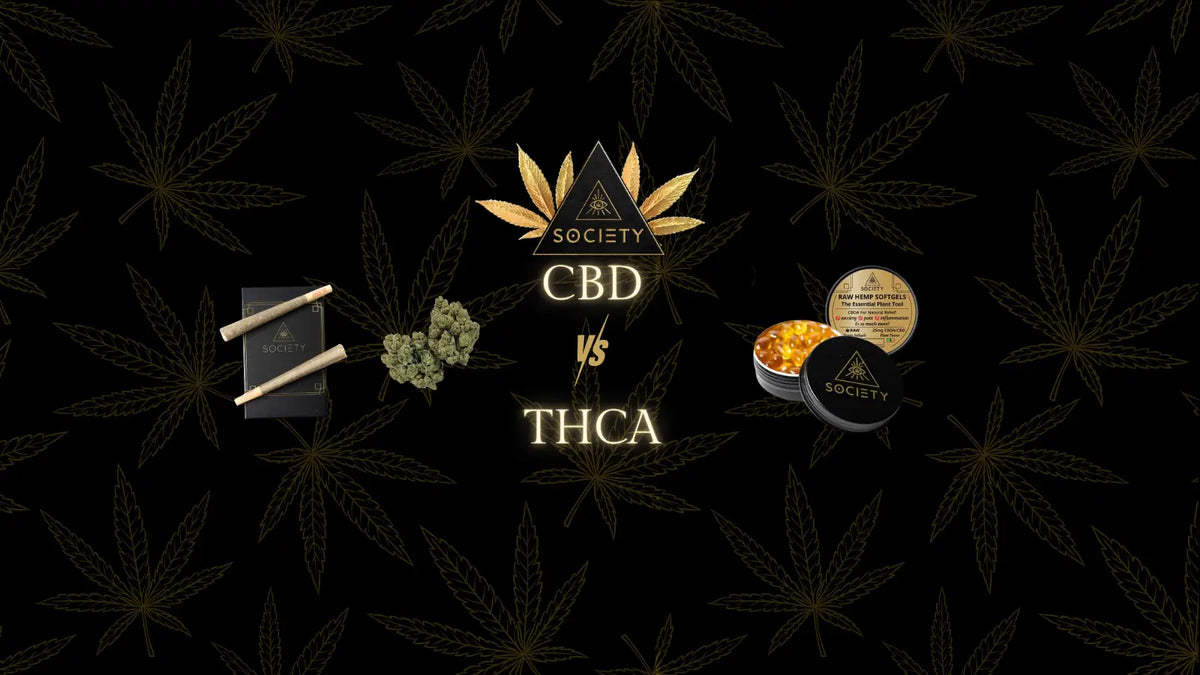
THCA vs CBD: The Answer You Need Before You Buy Cannabis Products
THCA and CBD are not the same cannabinoid. THCA converts to THC when it is heated and will get you high when smoked or vaporized, while CBD is non-psychoactive in every form and at every temperature. Understanding that difference is not just trivia; it determines whether you have a calm wellness moment or an unplanned couch situation at 3 pm before school pickup. Here is the clear, no-fluff breakdown of THCA vs CBD that moms need, including when to choose each one and exactly which Society's Plant products deliver what you are looking for.
What THCA and CBD Are: The Mom-Friendly Science. TL;DR
- THCA is raw and non-psychoactive inside the plant, but heat converts it to THC. Smoked or vaped THCA flower will get you high
- CBD is non-psychoactive at any temperature, and in any form, it will not get you high, ever
- If you want the full cannabis experience, relaxation, euphoria, and everything that comes with it, THCA flower is the answer
- If you want wellness benefits, reduced inflammation, better sleep, and less anxiety, without any psychoactive effect, CBD or CBDA is the answer
- They are completely different cannabinoids with different mechanisms, different effects, and different use cases. Choosing the wrong one is an expensive and potentially startling mistake
I Just Want to Know If It Gets Me High
Yes, THCA will get you high when you smoke or vaporize it. The raw, unheated form is non-psychoactive, but the moment heat is applied, a process called decarboxylation converts THCA into THC, which is the compound responsible for the psychoactive experience. If you are a mom who is cannacurious but nervous about the high, that one sentence is the answer you have been searching for at 11 pm.
CBD does not get you high at any dose, in any form, under any circumstances. It interacts with the endocannabinoid system through different receptors than THC, and it does not produce psychoactive effects. That distinction is why so many moms start with CBD and why CBDA softgels have become a cornerstone of the Society's Plant lineup for women who need wellness support without any unpredictable effects.
Which One Should I Actually Buy?
If you are planning to smoke or vaporize and you want the full cannabis experience, THCA flower is what you are looking for. If you want to take something orally that supports inflammation, sleep, or anxiety without any high, Raw CBDA softgels are the more targeted, higher-bioavailability choice. Keep reading because the side-by-side comparison below makes this decision straightforward.
Both THCA and CBD come from the cannabis plant, and both start out as cannabinoids with therapeutic potential. However, what happens to each one inside your body, and what happens to THCA the moment you apply heat, is where the comparison splits entirely. Here is what each cannabinoid is and why the mechanism matters before you spend a dollar on either one.
What Is THCA? The Cannabinoid That Changes When You Light It
THCA, or tetrahydrocannabinolic acid, is the raw, acidic precursor to THC that exists naturally in the cannabis plant before heat is applied. In its raw form, THCA does not bind to the CB1 receptors in the brain the way THC does, which is why raw cannabis does not produce a high. It is technically non-psychoactive in the plant, and on paper, it looks like a very different compound from THC.
The moment you apply heat, whether from a lighter, a vaporizer, or an oven, THCA undergoes decarboxylation and converts into delta-9 THC. That is the psychoactive compound. So when you see THCA flower vs CBD flower comparisons and you wonder why THCA is sold legally under the Farm Bill, the answer is that it is federally compliant in its raw form. What you do with it after that determines the experience.
For a deeper look at what decarboxylation does inside your cannabis and why it matters for moms who want to be informed about what they are consuming, this complete guide to decarboxylated cannabis breaks down the full science without talking down to you.
What Is CBD and Why Moms Keep Coming Back to It
CBD, or cannabidiol, is a non-psychoactive cannabinoid that works primarily through serotonin receptors and indirectly through the endocannabinoid system, rather than binding directly to the CB1 receptors that cause a high. It supports mood, inflammation, sleep, and anxiety in ways that are increasingly backed by research. It does not alter your perception, it does not make you feel impaired, and it does not show up in your body the way THC does.
CBDA is the raw, acidic precursor to CBD, and it is the form that Society's Plant has prioritized in its softgel formulations because of how dramatically it outperforms standard CBD on bioavailability. Research has shown that CBDA interacts directly with serotonin receptors, which is relevant for moms dealing with anxiety, nausea, and chronic stress. A 2013 study on CBDA and serotonin receptor activity found meaningful engagement with 5-HT1A receptors, the same receptors targeted by many anti-anxiety interventions. Society's Plant uses CO2-extracted CBDA specifically because that method preserves the raw acid form that standard CBD processing destroys.
The Key Difference Between THCA and CBD That Nobody Explains Clearly
The clearest way to understand the difference between THCA and CBD is this: THCA is a precursor to an intoxicating compound, and CBD is not. THCA becomes psychoactive with heat. CBD does not become psychoactive under any condition. They are not interchangeable; they do not produce the same effects, and they serve entirely different purposes in a wellness routine.
For moms who are asking, "Is THCA the same as CBD?" because they keep seeing both terms on hemp product labels, the short answer is no. They share a plant origin, and both have therapeutic potential, but they sit on completely opposite sides of the psychoactive line once heat is introduced. That line is the entire decision.
Key takeaway: THCA converts to THC when heated and will produce a high. CBD does not convert, does not produce a high, and works through an entirely different mechanism. These are not variations of the same thing.
THCA vs CBD Side-by-Side: Choosing the Right One for Your Life Right Now
Below is the direct comparison every mom deserves before she buys anything. The question is not which one is better. The question is which one matches what you are trying to feel, and when you are planning to take it.
|
Feature |
THCA Flower |
CBD / CBDA |
|
Psychoactive when smoked/vaped? |
Yes, converts to THC with heat |
No, non-psychoactive at any temperature |
|
Psychoactive when eaten raw? |
No, raw THCA does not produce a high |
No |
|
Best method of use |
Smoked or vaporized |
Oral softgel, tincture, or edible |
|
Onset time |
Minutes when inhaled |
45-60 minutes as a softgel |
|
Primary use cases |
Full cannabis experience, relaxation, euphoria, creativity |
Inflammation, anxiety, sleep, hormone balance, daily wellness |
|
Will it affect daily function? |
Yes, treat it like THC when smoked |
No psychoactive effect on daily function |
|
Farm Bill compliant? |
Yes, in raw form |
Yes |
|
Good for moms who need zero high? |
No |
Yes |
Choose THCA Flower When You Want the Full Experience
THCA flower is the right choice when you are intentionally choosing the full cannabis experience: the relaxation, the euphoria, the body and mind effect that comes with smoking or vaporizing quality flower. This is not a casual wellness supplement. It is cannabis in its most recognizable form, and it should be treated as such. If you are ready for that, Society's Plant's craft THCA flower delivers a smoking experience that is on par with dispensary-quality cannabis in terms of terpene profile and cultivation care.
Tad Snyder, co-founder of Society's Plant, has been involved in cannabis cultivation since 2012, and that experience is reflected in the quality and intentionality of every strain in the THCA lineup. This is not commodity hemp tossed in a bag. It is grown and selected the way cannabis should be.
Choose CBD or CBDA When You Need Wellness Without the High
CBD and CBDA are the right choice when you want the anti-inflammatory, calming, and sleep-supportive effects of cannabis without any psychoactive component. For moms who are managing the mental load of running a household, showing up for their kids on no sleep, and trying to find something that takes the edge off without affecting their ability to function, CBDA softgels are formulated specifically for that need.
The full comparison of CBDA vs CBD for moms dealing with pain is worth reading if inflammation is your primary concern, because the bioavailability difference between raw CBDA and processed CBD is significant enough to affect your results.
What About CBDA? Why the Raw Form of CBD Is Worth Understanding
CBDA is the form CBD takes before it is processed, and it is 10 to 18 times more bioavailable than standard CBD according to pharmacokinetic research. That means your body absorbs and uses significantly more of it per milligram. For moms who have tried CBD and felt like it did not do much, the issue may not have been the dose; it may have been the form. Society's Plant formulates with CO2-extracted CBDA in its softgels specifically because the raw form reaches your bloodstream more efficiently. A 2008 study on CBDA and COX-2 enzyme inhibition also showed promising anti-inflammatory activity, which is directly relevant for moms dealing with chronic physical tension and inflammation from years of carrying everything, literally and otherwise.
Key takeaway: THCA flower is for the mom choosing the full cannabis experience with her eyes open. CBD and CBDA are for the mom who needs daily support without any psychoactive effect. Both are valuable; they just serve different versions of what you need right now.
What Moms Who Have Tried Both Actually Said
When you are choosing between THCA and CBD for the first time, it helps to hear from women who have already navigated the same decision. Here is what three moms from the Society's Plant community shared after trying both sides of the comparison.
"I was burned out, touched out by 4 pm every single day, and I thought CBD was doing nothing for me," says Tori, 41, a stay-at-home mom from rural Ohio. "I switched to the CBDA softgels, and within two weeks, I noticed I was not snapping at my kids by dinnertime. The inflammation in my hips was quieter. I had no idea the form of CBD I was taking made that much difference."
"I had tried CBD gummies from three different brands and felt absolutely nothing," says Jade, 36, an educator from Charlotte, NC. "A friend told me about Society's Plant THCA flower, and I want to be clear, I knew it would get me high, and I chose that intentionally on a Friday night after a week that nearly broke me. It was everything I needed. But the CBDA softgels are what I take on school days. They are completely different tools."
"I kept seeing 'cbd vs thca' in my search history and I realized I had no idea what I was actually buying," says Nikki, 33, a new mom from Austin, TX. "Starting with the CBDA softgels was the right call. No high, no anxiety about how I would feel, just actual support for the sleep deprivation and the 3 pm crash I had been white-knuckling through for a year."
The Pros and Cons Because You Deserve the Unvarnished Version
No product comparison should skip the downsides. Here is what to weigh before you choose.
THCA Flower: Pros
- Fast onset when smoked or vaporized, often within minutes, which means you are not waiting an hour to know if it worked
- Full-spectrum cannabis experience, including the entourage effect of terpenes, cannabinoids, and plant compounds working together
- Craft quality is available, specifically at Society's Plant, where cultivation expertise means you are getting flower grown with intention, not commodity hemp
- For moms who are choosing the full cannabis experience intentionally, THCA flower delivers exactly what it promises
THCA Flower: Cons
- It converts to THC when heated, which means it is absolutely not the right choice if you need zero psychoactive effect during any part of your day
- Requires heat to activate, you cannot eat THCA flower raw and expect a cannabis experience
- Not appropriate if you are in a situation where any THC exposure is a concern (see FAQ below for the full note on this)
CBD and CBDA: Pros
- Non-psychoactive at any dose in any form, which makes it compatible with every part of mom life including school pickup, work, and parenting
- CBDA's 10 to 18x greater bioavailability over standard CBD means you get more from every milligram
- Supports inflammation, sleep, mood, and anxiety through mechanisms backed by published research, not marketing claims
CBD and CBDA: Cons
- Standard CBD has significantly lower bioavailability than CBDA, which is why moms who only try processed CBD often feel like it does not work, the issue is form, not the cannabinoid itself
- Softgels take 45 to 60 minutes to take effect, so they require a little planning if you are targeting a specific window like the 3pm crash or a stressful evening
Key takeaway: THCA flower is a high-quality choice with a real psychoactive effect, that is not a flaw, it is a feature when chosen intentionally. CBDA softgels are the daily, non-negotiable wellness option for moms who need support without any high.
Society's Plant Products That Make This Decision Straightforward
Society's Plant is a Michigan hemp farm founded in 2019 by Bianca Snyder, who has built an online community of over 130,000 mothers and serves over 10,000 customers by formulating products around specific outcomes rather than just milligram counts. With a Farm Bill compliant lineup that is third-party lab tested, and co-founder Tad Snyder bringing cannabis cultivation expertise since 2012, Society's Plant approaches wellness with intention, transparency, and actual science.
THCA Flower: Tropicana Cookies, For the Mom Who Is Ready for the Full Experience
Tropicana Cookies is a Society's Plant craft THCA strain that delivers what experienced cannabis consumers are looking for: a vibrant terpene profile, quality flower that smokes clean, and the full converted-THC experience when vaporized or smoked. This is not the product for a first-time cannabis user or a mom who needs to stay sharp for the rest of her day. This is for the mom who has made a deliberate choice to set aside intentional time for herself and who wants to feel the full weight of that decision lift.
You can shop craft THCA flower and see the full lineup including Tropicana Cookies with lab results published at societysplant.com/pages/labs. For a detailed breakdown of how THCA flower compares to CBD flower in terms of effect, onset, and use case, the THCA flower vs CBD flower full breakdown covers every angle.
Raw CBDA Softgels, For the Mom Who Wants Wellness Without the High
The Raw CBDA softgels from Society's Plant are CO2-extracted, third-party lab tested, and formulated to deliver the anti-inflammatory and calming benefits of CBDA at a bioavailability level that standard CBD products simply cannot match. For the mom who wakes up already exhausted, who has lost herself somewhere inside years of caregiving, who is touching out by 4pm and running on cortisol and caffeine by 3pm, these softgels are formulated for her specifically. Not in a vague, wellness-marketing way. In a this-is-the-form-your-body-actually-absorbs way.
These are the reason CBDA outperforms standard CBD for pain and inflammation in head-to-head comparisons. Plan for 45 to 60 minutes onset time and take them consistently, because the cumulative effect of daily CBDA use builds over time in a way that a single dose cannot capture.
FAQ: THCA vs CBD, The Questions Moms Are Actually Asking
Does THCA Get You High?
Yes, THCA gets you high when it is smoked or vaporized. In its raw, unheated form inside the plant, THCA is non-psychoactive and does not produce intoxication. However, the moment heat is applied, decarboxylation converts THCA into delta-9 THC, which is the compound responsible for the psychoactive cannabis experience. So when you are asking whether THCA flower will get you high, the answer is yes if you smoke or vaporize it. No if you somehow consumed it completely raw and unheated, which is not how most people use it. For moms who are cannacurious but nervous about the high, this is the single most important thing to understand before you buy. For the full science on what happens when cannabis is heated, this guide to THC vs THCA covers the conversion process in plain language.
Does CBD Get You High?
No, CBD does not get you high, and it will not get you high at any dose or in any form. CBD works through different receptors than THC and does not produce psychoactive effects. CBDA, the raw precursor form of CBD used in Society's Plant softgels, also does not produce any psychoactive effect. For moms who need to stay fully present and functional, managing school pickup anxiety, handling the mental load of running a household, getting through a workday without any impairment, CBD and CBDA are safe to take without concern about any high. Everyone's endocannabinoid system responds differently in terms of how much benefit they feel, but the psychoactive question has a flat, consistent answer: no.
Is THCA the Same as CBD?
No, THCA is not the same as CBD, and this is one of the most important distinctions in the hemp space right now. THCA is the raw precursor to THC. CBD is a separate cannabinoid entirely with a completely different chemical structure, mechanism of action, and set of effects. The only thing they share is that both come from the cannabis plant and both are sold under the Farm Bill as hemp-derived cannabinoids. Beyond that, they diverge completely: THCA becomes psychoactive when heated, CBD never does, they interact with different receptor systems, and they are used for different purposes. Calling them the same thing is like saying ibuprofen and melatonin are the same because they both come in a pill. For a deeper breakdown of the comparison, this guide to CBDA vs CBD covers the full spectrum of how these cannabinoids differ.
What Is the Difference Between THCA Flower and THC Flower?
THCA flower and THC flower produce the same effect when smoked or vaporized because they become the same compound through heat. The primary difference is legal classification: THCA flower is hemp-derived, Farm Bill compliant, and sold legally online in most states because its delta-9 THC content is below 0.3% in the raw plant. THC flower from a dispensary contains delta-9 THC that is already decarboxylated and is classified as marijuana under federal law. When you smoke or vaporize Society's Plant THCA flower, the experience is comparable to cannabis from a dispensary. The cultivation standards, terpene quality, and strain selection determine the experience, which is why sourcing from a farm with real cultivation expertise since 2012 matters.
Which Is Better for Pain: THCA or CBD?
For moms dealing with chronic inflammation, joint pain, muscle tension, or the kind of full-body ache that comes from years of carrying children and carrying everything else, CBDA softgels are the more targeted and better-absorbed choice. CBDA has been shown in a 2008 study on CBDA and COX-2 enzyme inhibition to have meaningful anti-inflammatory activity, and its 10 to 18x greater bioavailability over standard CBD means more of what you take is actually used by your body. THCA, when smoked or vaporized, may provide faster temporary relief because of quick onset, but it is not a daily anti-inflammatory protocol. For pain that needs consistent management rather than a quick window of relief, Raw CBDA softgels are the more practical, sustainable option.
Which Is Better for Sleep: THCA or CBD?
Neither THCA flower nor CBD alone is the most targeted option for sleep, but if you are choosing between the two, CBDA softgels taken consistently are more appropriate for moms who never get a full night of sleep and need something that supports the nervous system without a high. THCA flower smoked before bed may help with relaxation and can promote sleep for some people, but it is not formulated specifically for sleep architecture the way Society's Plant sleep products are. For moms whose primary struggle is waking up already exhausted and cycling through another day on broken sleep, theGood Night CBN Gummies are specifically formulated for sleep with 40mg CBD and 20mg CBN, and they address the problem more directly than either THCA flower or a standard CBD softgel used alone.
Is THCA Safe? Will It Show Up on a Drug Test?
THCA from a reputable, third-party tested source like Society's Plant is Farm Bill compliant and produced with lab transparency, you can review COAs at societysplant.com/pages/labs. For most people using quality hemp products responsibly, safety is not a primary concern when the product is clean, tested, and accurately labeled. However, drug testing is a real consideration for moms in professions with testing requirements. When THCA is smoked or vaporized, it converts to THC, and THC is metabolized into the same compounds that drug tests screen for. Naturally occurring THC from hemp may show up on a drug test with regular use. This applies to THCA flower specifically because you are converting it to THC when you use it. CBD and CBDA softgels contain trace amounts of THC due to full-spectrum formulation, so they are also worth considering carefully if you are in a tested profession. When in doubt, consult your employer's policy and your healthcare provider.
THCA and CBD are not rivals. They are two different tools for two different versions of the same mom: the one who is ready to feel everything, and the one who just needs to feel nothing except better. Neither choice is wrong. Both are valid. The only mistake is choosing without knowing the difference, and now you do.
Related Guides Worth Reading
- Why THCA flower and CBD flower produce completely different experiences, and how to know which one belongs in your routine
- Why CBDA outperforms standard CBD for pain and inflammation, and what that means for your dose
- The full guide to edibles for burned-out moms, what works, what does not, and where to start when you have tried everything
- What decarboxylation actually does to cannabis and why it determines everything about the product you buy
These statements have not been evaluated by the Food and Drug Administration. This product is not intended to diagnose, treat, cure, or prevent any disease. Consult a healthcare professional before starting any new supplement.

Leave a comment
This site is protected by hCaptcha and the hCaptcha Privacy Policy and Terms of Service apply.