
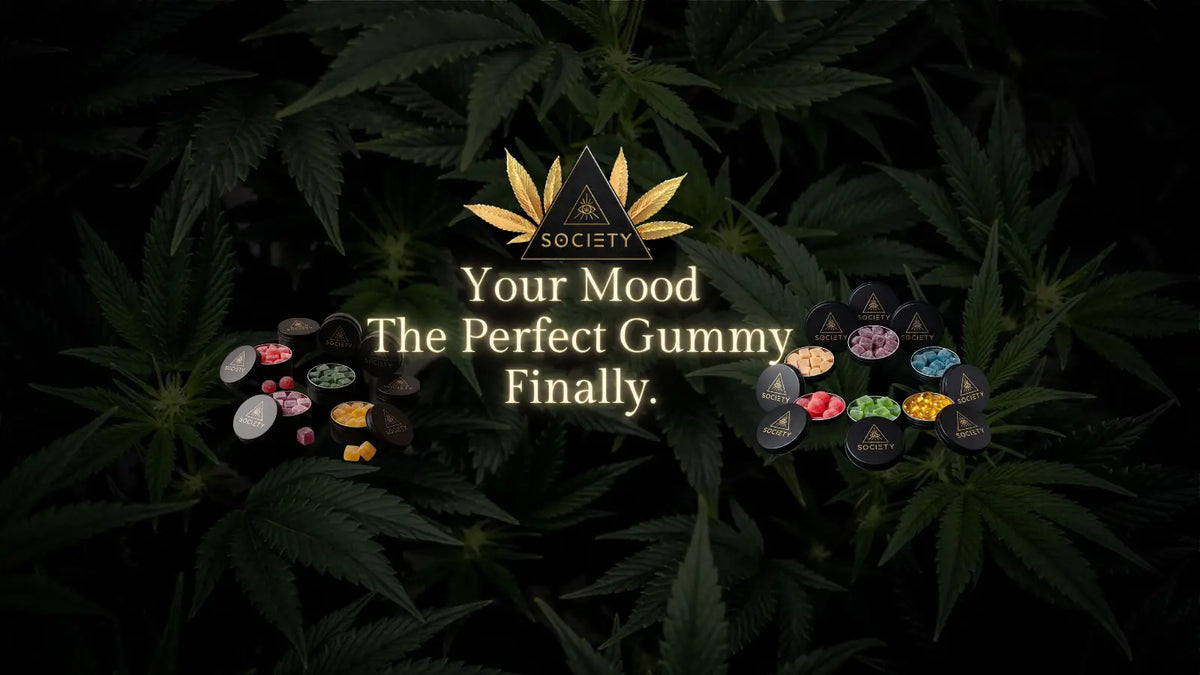
Mood Gummies: Find the Right Gummies for Your Mood
Mood gummies are edible hemp supplements formulated with specific cannabinoids like THC, CBG, CBD, and THCV to support a targeted emotional state, whether that's calm, focus, energy, or evening wind-down. Society's Plant builds each of its gummies for mood around a distinct cannabinoid stack, so every formula does something intentional rather than just delivering a generic hemp extract. If the options feel overwhelming, this guide breaks down exactly how microdosing works, what the science says, and which product fits the effect you're actually after.
How Canna Mood Gummies Work: The Endocannabinoid Science Worth Knowing? TL;DR
- Mood gummies use cannabinoids at low, deliberate doses to support emotional balance, not to produce intoxication.
- Microdosing gummies deliver 1.5mg to 5mg of THC per serving, typically stacked with CBG, CBD, or THCV for a more targeted effect.
- Different formulas do genuinely different things: Good Day CBG Gummies suit mornings,Focused Microdose Gummies are built for midday clarity, and High Spirits Microdose Gummies are the after-work option.
- Onset for all gummies is 30 to 45 minutes, so timing matters more than most people expect.
- The right gummy depends on what you want to feel and when, not just what's in stock.
So You Want to Feel Better Without Losing the Plot
There's a specific kind of bad day that doesn't call for a dramatic intervention. It's not a crisis. It's more like a sustained, low-grade friction between how you feel and how you'd like to feel, and it sits somewhere between "fine" and "actually good." Mood enhancing gummies were built for exactly that gap.
The appeal isn't getting stoned. For most adults using gummies for mood, the goal is smaller and more practical: less background static, more access to the version of themselves that functions well. Society's Plant's lineup sits in that space deliberately, with cannabinoid doses calibrated so the effect shows up without taking over your afternoon.
Furthermore, these aren't products built around a vague wellness promise. Each formula was developed with a specific use case in mind, which means choosing the right one is less about trial-and-error and more about matching the formula to what you actually need.
Are Mood Gummies the Same as Regular Edibles?
Regular edibles were historically optimized for one outcome: getting high. Mood boosting gummies are a different category entirely. The THC doses are lower, the supporting cannabinoids are doing meaningful work, and the intent is functional rather than recreational.
Additionally, the supporting cast matters enormously. CBG, CBD, THCV, Lion's Mane, and L-Theanine aren't filler ingredients added for label appeal. Each one interacts with different receptors and biological pathways to shape the overall effect profile. A 5mg THC gummy stacked with CBG will feel noticeably different from a 5mg THC gummy on its own, and that distinction is precisely what separates canna mood gummies from a generic dispensary edible.
Because the doses are low and the formulas are intentional, mood edibles occupy a category that recreational cannabis never really addressed: daily, functional support for the ordinary grind.
Bottom line: mood gummies are not a lighter version of recreational edibles. They're a different product built for a different purpose.
Understanding why mood edibles do what they do makes it significantly easier to choose the right one. The short version involves a system most people don't know they have, and it's been running in the background the entire time.
What Cannabinoids Are Doing to Your Endocannabinoid System
The human body runs an internal regulatory network called the endocannabinoid system (ECS), which governs mood, stress response, sleep, appetite, and several other functions that collectively determine whether a person feels like a functioning adult or a slightly overwhelmed one. The ECS operates through receptors, primarily CB1 and CB2, that respond to both the body's own endocannabinoids and the plant-derived cannabinoids in hemp.
THC, even at the low doses used in microdosing gummies, interacts with CB1 receptors in the brain in ways that can support mood, reduce the perception of stress, and lower baseline tension. CBD works through different pathways, including serotonin receptor activity and anti-inflammatory mechanisms, contributing to a broader sense of calm without producing noticeable sedation. That layering is why a well-formulated mood gummy feels more grounded and more useful than a crude high-dose product.
For a deeper look at how this plays out in practice, this guide on how microdose gummies work for everyday mood support breaks down the ECS mechanism alongside real-world dosing observations from Society's Plant's community.
Key takeaway: cannabinoids don't create a mood out of nowhere. They interact with the system your body already uses to regulate one.
Why CBG Is the Quiet Overachiever in Mood Edibles
Cannabigerol, better known as CBG, earns its place in nearly every Society's Plant mood formula because of what it does at the receptor level. CBG interacts with both CB1 and CB2 receptors, and it also influences alpha-2 adrenergic receptors, which are involved in focus, attention, and calm wakefulness.
Additionally, CBG may support serotonin activity, connecting it directly to the biology of mood regulation. In practice, CBG tends to produce a clear-headed, present quality rather than the heavier body sensation associated with higher THC doses. That's why it anchors multiple Society's Plant formulas, where the goal is usable clarity, not sedation.
Tad Snyder, who has worked in cannabis cultivation since 2012, brought an early understanding of cannabinoid interactions to Society's Plant's formulation process. The emphasis on CBG as a mood-supporting backbone, rather than relying on THC alone, reflects that background. It's a decision rooted in how these compounds actually behave together, not in what sounds good on a label.
CBG is not a trendy add-on. It's a mechanistically distinct cannabinoid that changes the character of the effect when stacked with THC.
The Difference Between Getting High and Getting in Balance
Getting high, in the traditional sense, involves THC doses high enough to produce noticeable intoxication: altered perception, impaired coordination, short-term memory shifts. Getting in balance describes what happens when the ECS receives just enough cannabinoid input to stop compensating for a deficit and start functioning closer to baseline.
The difference is the dose. Five milligrams of THC stacked with CBG will feel very different from 25mg of THC alone, and that difference isn't just quantitative. The additional cannabinoids shape the character of the effect, smoothing edges that pure THC can sometimes amplify. For people new to mood THC gummies, this distinction is the most important one to understand before trying anything.
Everyone's endocannabinoid system responds differently. Two people can take the same gummy at the same dose and report meaningfully different experiences, which is exactly why starting low and paying attention to your own response matters more than any dosing rule of thumb.
Getting in balance is not a euphemism for getting high. They are genuinely different physiological states.
Microdosing Gummies: How Much to Take, When to Take It, and Why Less Is a Legitimate Strategy
Microdosing means taking a sub-intoxicating amount of THC, typically between 1.5mg and 5mg, with the goal of experiencing the mood-supporting benefits of cannabinoids without the altered state that higher doses produce. It is not a compromise. For most adults using mood boosting gummies as part of a daily routine, it's the optimal dose range.
First-Timers: What a Proper Microdose Feels Like
A proper microdose doesn't feel like much, and that's the point. Most people describe it as a slight lifting of the background weight they were carrying, a bit more access to patience, a bit less friction between tasks. It is subtle enough that some people miss it entirely on the first try and assume the product didn't work.
What it doesn't feel like is being stoned. If a microdose produces noticeable intoxication, the dose is too high for that person's system, which varies significantly based on body weight, metabolism, prior cannabis experience, and whether the gummy was taken with food. For anyone new to microdosing gummies, starting with half a gummy and waiting a full 30 to 45 minutes before considering a second half is not timidity. It's how the best outcomes happen consistently.
The Focused Microdose Gummies at 2mg THC are specifically designed to be the most approachable entry point for first-timers who are curious but cautious about THC.
Timing, Onset, and the 30 to 45 Minute Rule
All gummies take 30 to 45 minutes to produce noticeable effects. This is not a Society's Plant quirk; it's how oral cannabinoid absorption works. The gummy is digested, the cannabinoids are processed through the liver, and the effects build gradually rather than arriving all at once.
The single most common mistake new users make is taking a second gummy at the 20-minute mark because they don't feel anything yet. Taking more before the first dose has fully activated doubles the dose and doubles the effect, which rarely produces the balanced, functional experience someone was looking for. Set a timer. Wait the full window. Evaluate from there.
Because onset is gradual, planning is more useful than reacting. Taking a mood gummy in response to an already-bad moment is less effective than taking it as part of a predictable daily window, before the stress arrives rather than after it has already settled in.
Daytime vs. Evening: Picking the Right Time Window
The time of day matters as much as the product itself, because different formulas are built for different windows. Society's Plant structures its mood gummy lineup around this idea explicitly.
Mornings belong to Good Day CBG Gummies, which contain 1.5mg THC alongside CBG and Lion's Mane for a clear, supported start to the day. Midday, from roughly noon to 2pm, is the sweet spot for the Focused Microdose, which is designed for sustained attention and mood elevation through the afternoon. The 3pm to 6pm window, the one that used to involve a glass of wine, is whereHigh Spirits Microdose Gummies land best: after the work day's peak demand, before dinner, when the goal is decompression rather than productivity.
For a practical guide to building this into an existing routine, this breakdown of microdose gummies for calm, clarity, and balance covers how real people structure these windows.
Picking the right timing window for your mood gummy is not optional. It's part of the formula.
What People Are Saying About Mood Boosting Gummies From Society's Plant
Customer feedback reveals patterns that formulation notes can't always capture. Three responses from Society's Plant's community illustrate how mood edibles work in actual daily life, not in a controlled setting.
"I'd been skeptical about mood gummies for a long time because I assumed they'd either do nothing or make me feel fuzzy when I needed to be sharp. The Good Day gummies changed that entirely. I take one with my morning coffee around 8am and by the time I'm at my desk I notice I'm just... less reactive. Less likely to spiral on something small. I'm a corporate attorney in Dallas and that particular quality is worth a lot.", Carla, corporate attorney, Dallas TX
"I tried the Focused Microdose at 1pm on a Tuesday when I had three hours of writing to get through and was completely stalled. I took one, waited the 45 minutes, and the focus that showed up was quiet and sustained, not jittery or artificial. It's become the 1pm ritual I didn't know I needed. I describe it to my friends as the opposite of that second cup of coffee that makes everything worse.", Nikki, freelance designer, Portland OR
"I genuinely didn't think gummies for mood would work for me because I'd tried CBD gummies from a different brand and felt nothing. High Spirits is different. I take half a gummy around 4pm and it's the most effective end-of-day reset I've found. I'm calmer at dinner, more present with the people around me, and I don't wake up feeling like yesterday happened to me.", Raquel, restaurant owner, New Orleans LA
The Honest Pros and Cons of Mood Enhancing Gummies: What to Weigh Before You Buy
Mood enhancing gummies are genuinely useful for a lot of people. They are also not for everyone, and pretending otherwise would be a disservice. Here is what the tradeoffs look like without the marketing layer.
Three Specific Pros Worth Understanding
The effect is cannabinoid-specific, not generic. Because each Society's Plant formula pairs THC with a specific supporting cast of CBG, THCV, or functional mushrooms, the mood support is shaped rather than indiscriminate. You're not just muting everything. You're nudging a specific receptor profile toward a specific state.
Low doses mean low stakes for most people. At 1.5mg to 5mg of THC, the margin for a bad experience is narrow. This dose range is forgiving in a way that 10mg or 25mg products are not, which makes mood gummies a practical starting point for anyone who wants to explore cannabinoid support without committing to a full recreational dose.
The effects last. Because gummies are metabolized rather than inhaled, the effects typically run four to eight hours. That duration makes them suited to sustained support across a morning, an afternoon, or an evening, rather than a brief window that requires re-dosing.
Two Cons Worth Knowing
The onset requires planning. Thirty to 45 minutes means mood gummies are not a reactive tool. If you need immediate support in a high-stress moment, a gummy you take right then won't arrive in time. The reframe: this limitation encourages building a consistent daily practice rather than treating mood support as crisis management, which produces better outcomes anyway.
Individual response varies significantly. One person's "gentle lift" is another person's "I need to sit down for a minute." Because endocannabinoid systems differ, the same dose will land differently across different people. The reframe: this isn't a flaw in the product. It's an argument for starting with half a gummy, tracking your response, and adjusting from a place of information rather than assumption.
The honest summary: mood edibles are useful, incremental, and calibratable. They reward patience and penalize impulsiveness.
Gummies for Mood by Effect: A Product Breakdown for the Effect You Want
The best mood gummy is the one built for the specific state you're trying to reach. Below is a breakdown of Society's Plant's four core mood formulas by effect, time of day, and use case, so the choice is a matter of matching rather than guessing.
- Relax (afternoon wind-down, alcohol replacement, end-of-day decompression): High Spirits Microdose Gummies (5mg THC + CBG). Best in the 3pm to 6pm window. Start with half a gummy if it's your first time. This is the formula built for the moment the day stops requiring full output and starts asking for something else.
- Focus (midday clarity, sustained attention, mood elevation without sedation): Focused Microdose Gummies (2mg THC + 2mg THCV + 10mg CBG + 200mg Lion's Mane + 50mg L-Theanine). Best taken around noon to 1pm. Also the most approachable first-time THC option for anyone who wants to start at the lowest possible dose.
- Energize / Morning Mood Support (clear, functional start to the day): Good Day CBG Gummies (CBG + CBD + 1.5mg THC + Lion's Mane). Best taken in the morning. The 1.5mg THC is a low amount and most people don't notice intoxication, though individual responses vary. Compatible with a productive morning.
- Get in the Mood (intimacy, connection, sensory presence): Passion Gummies (1.5mg THC + 50mg CBD). Formulated for the pleasure collection specifically, these gummies are built to support relaxation and physical ease in an intimate context. Different intent, different formula, worth keeping separate from the other mood categories.
Relax: When You Need to Come Down Without Checking Out
High Spirits Microdose Gummies are specifically formulated for the window between the end of the work day and the beginning of the evening. The 5mg THC dose is enough to produce a noticeable mood shift without the sedation that higher doses bring, and the CBG component supports a clear-headed quality that keeps the effect functional rather than floaty.
For anyone who has used alcohol as an end-of-day ritual and found the trade-off unsatisfying, High Spirits occupies the same time slot with a different physiological outcome. No disrupted sleep, no next-morning fog, no calorie surplus. Just the decompression the ritual was always supposed to provide.
Start with half a gummy. The 5mg dose is the most THC of the three core mood formulas, and a half gummy at 2.5mg is a reasonable first entry point for anyone new to this product specifically.
Focus: When Your Brain Needs a Nudge, Not a Nap
The Focused Microdose Gummies are the most complex formula in Society's Plant's mood lineup, and the complexity is intentional. The 2mg THC provides a gentle mood lift. The 2mg THCV supports energy and mental sharpness without appetite stimulation. The 10mg CBG contributes to the clear-headed, attentive quality described in the CBG science section. And the 200mg Lion's Mane combined with 50mg L-Theanine rounds out the stack with functional mushroom and amino acid support for sustained cognitive focus.
This is the formula for midday, specifically for the hours when the morning's momentum has stalled and a nap is not an option. It doesn't produce stimulation in the way caffeine does. It produces access, which is a subtler thing and generally more useful for deep work.
Additionally, because the THC dose is the lowest in the lineup at 2mg, this is also the most forgiving option for anyone taking a mood THC gummy for the first time. The room for an uncomfortable experience at this dose is genuinely narrow.
Key takeaway: Focused Microdose is not just a focus product. It's also the softest on-ramp into THC-containing mood gummies available in Society's Plant's entire catalog.
Do Mood THC Gummies Fit in a Daily Wellness Routine? The Case For and Against Regular Use
Using mood edibles consistently produces different outcomes than reaching for one when things have already gone sideways. The distinction matters, and it's worth thinking through before building any habit around these products.
What Consistent Use Looks Like vs. Using Them Only in Crisis Mode
Consistent use means taking a mood gummy at a predictable time as part of a daily structure: the Good Day gummy with morning coffee, the Focused Microdose at noon, or High Spirits at 4pm as a scheduled wind-down. In this model, the cannabinoids are supporting the ECS as part of a routine rather than being called in to manage an already-dysregulated state.
Crisis-mode use, by contrast, means taking a gummy only when things are already bad. This approach works less reliably because gummies take 30 to 45 minutes to produce effects. Furthermore, reaching for a mood gummy reactively, after the cortisol spike has already arrived, means the timing often misses the moment. The product is sound; the application is inefficient.
Neither approach is wrong for everyone. However, the community patterns from Society's Plant's 130,000-person following consistently show that people who build a structured daily routine around microdosing gummies report more reliable and satisfying outcomes than those who use them sporadically.
How Mood Edibles Fit Alongside Other Wellness Habits
Mood edibles are not a replacement for sleep, movement, nutrition, or stress management. They are a complement to those habits, most effective when the other foundations are reasonably in place. Thinking of them as a mood-support layer on top of an existing wellness structure is more accurate than thinking of them as a fix for a system that isn't working at all.
That said, they pair well with practices that involve the ECS broadly. Low-intensity exercise, for example, supports endocannabinoid production naturally. Taking a morning mood gummy on a day that includes movement is likely to produce a different experience than taking it on a day that doesn't. These interactions aren't dramatic, but they're real, and paying attention to them helps calibrate the right product and dose for any individual's life.
If you're exploring where mood gummies intersect with anxiety support specifically, this guide on the best THC gummies for anxiety covers the overlap and the important distinctions between mood support and anxiety support as separate goals.
Mood gummies work best as a consistent daily input, not a sporadic rescue tool.
Best Microdose Gummies at Society's Plant: Which Formula Is Built for What
Society's Plant carries three primary mood-focused microdose formulas, and they are not interchangeable. Here is a direct comparison table to make the differences concrete before committing to one.
|
Product |
THC Dose |
Key Supporting Ingredients |
Best Time |
Primary Effect |
|
5mg THC |
CBG |
3pm to 6pm |
Relaxed mood lift, decompression, alcohol replacement |
|
|
2mg THC |
2mg THCV, 10mg CBG, 200mg Lion's Mane, 50mg L-Theanine |
Noon to 1pm |
Sustained focus, midday mood elevation, soft first-time entry |
|
|
1.5mg THC |
CBG, CBD, Lion's Mane |
Morning |
Clear-headed mood support, calm energy, functional start |
High Spirits vs. Focused Microdose: Not the Same Experience
High Spirits and Focused Microdose are both microdose gummies, but comparing them is like comparing a Thursday evening and a Tuesday afternoon. They serve different parts of the day and different versions of what feeling good actually means in context.
High Spirits at 5mg THC is the highest-dose option in the mood lineup. It is built for a time when the day's demands have lifted and the body is ready to let something go. The CBG support keeps the effect clear rather than heavy, but this is the formula designed to produce a noticeable mood shift, not just a subtle one. First-timers should start with half.
Focused Microdose, by contrast, is designed for use during active hours. The 2mg THC combined with THCV, CBG, Lion's Mane, and L-Theanine produces a stack aimed at cognitive support and mood elevation simultaneously, without the softer, more relaxed quality that High Spirits delivers. Using them interchangeably, taking High Spirits at noon or Focused Microdose at 5pm, would produce outcomes mismatched to the situation.
Good Day CBG: The One for Mornings That Need to Function
Good Day CBG Gummies are the morning-appropriate option in Society's Plant's mood lineup. The 1.5mg THC is a low amount, and most people find it compatible with a functional, productive morning. Because individual responses vary, start with one gummy and observe how your body responds before adjusting.
The Lion's Mane in Good Day adds a functional mushroom layer to the cannabinoid base, supporting cognitive clarity alongside the mood component. CBG's contribution to calm, focused wakefulness makes this formula well-suited to mornings that require showing up fully rather than coasting.
It is worth stating clearly: Good Day contains 1.5mg THC. It is not a zero-THC product. For anyone who needs a zero-THC morning option, Society's Plant's functional mushroom tinctures, including the Thrive Tincture, are the only products in the catalog with no THC whatsoever.
Good Day is a morning product. High Spirits is not. Swapping them will produce the wrong experience at the wrong time.
Mood Gummies FAQ: The Follow-Up Questions Worth Answering
Which gummies make you feel happy?
The gummies most associated with a lifted, positive mood are those that combine low-dose THC with CBG, which influences serotonin receptor activity and supports a clear-headed sense of wellbeing. Society's Plant's High Spirits Microdose Gummies are the most frequently cited for producing that particular quality, and the Good Day CBG Gummies deliver a gentler version of the same lift during morning hours. The effect is not euphoria in the recreational sense. It is more accurately described as mood support that removes friction and supports a more positive baseline. For a broader look at how mood gummies compare across the lineup, these community reviews on gummies for mood include specific product feedback from people who have used them consistently.
Do mood gummies actually work?
Mood gummies work through a real and well-documented biological mechanism: cannabinoids interact with the endocannabinoid system, which regulates mood, stress response, and emotional regulation. The question isn't whether the mechanism is real; it is whether the dose, timing, and formula are matched to the individual. At the low doses used in microdosing gummies, effects are subtle and may be easy to miss on the first attempt. People who take a mood gummy once, feel nothing dramatic, and conclude the category doesn't work are usually missing two things: sufficient patience with the 30 to 45 minute onset window, and consistency over multiple days. The ECS responds to sustained input differently than it responds to a single dose, and most people who report that mood edibles work for them describe the effect becoming more reliable with consistent use over one to two weeks.
What gummies help with mood?
The gummies most effective for mood support are those that pair THC with CBG, because the combination addresses both the ECS's CB1 receptors (through THC) and the serotonin and adrenergic pathways that CBG influences. Society's Plant's entire mood lineup is built around this combination, with each formula differentiated by dose and additional functional ingredients. Good Day CBG Gummies work for mornings, Focused Microdose Gummies support midday mood and focus, and High Spirits Microdose Gummies are built for the afternoon and early evening. Choosing the right one depends on when and how you want to feel better, which is why the timing guidance in this post matters as much as the ingredient list.
Are there gummies that help you get in the mood?
Yes, and the distinction between "mood" in the emotional-balance sense and "in the mood" in the intimacy sense is worth drawing cleanly. Society's Plant's Passion Gummies, formulated with 1.5mg THC and 50mg CBD, are specifically built to support relaxation, physical ease, and sensory presence in an intimate context. They are part of Society's Plant's pleasure collection and serve a genuinely different purpose than the daytime and evening mood formulas covered in the rest of this guide. If that's the use case, that's the product. It is worth noting that all THC-containing products at Society's Plant, including Passion Gummies, carry the same caveat: naturally occurring THC from hemp may show up on a drug test with regular use.
Closing: The Gummy on the Counter Is Not Going to Choose Itself
The difference between a mood gummy that works and one that sits in a drawer is not the quality of the hemp. It's whether the formula matches the moment. A 5mg THC gummy taken at 8am by someone who needed calm focus is going to produce a very different outcome than the same gummy taken at 4pm when the day is finally done. Society's Plant built its lineup around this reality, not around the idea that one product serves every situation equally well.
Pick the time window first. Then pick the formula that fits it. Take less than you think you need, wait the full 30 to 45 minutes, and adjust from there. That sequence produces more reliable results than any amount of label-reading.
Browse the full Society's Plant gummies collection to see every formula, dose, and ingredient list in one place.
Related Guides Worth Reading
- How microdose gummies actually work: a practical breakdown of doses, timing, and what to expect
- The best edibles for focus: how microdose THC supports clarity without the jitter
- Gummies for mood: what Society's Plant customers are actually saying after consistent use
- Best THC gummies for anxiety: how mood support and anxiety support overlap and where they differ
These statements have not been evaluated by the Food and Drug Administration. This product is not intended to diagnose, treat, cure, or prevent any disease. Consult a healthcare professional before starting any new supplement.


Leave a comment
This site is protected by hCaptcha and the hCaptcha Privacy Policy and Terms of Service apply.